

How would it be like to have immediate access to real-time data? No inconsistencies or delays—just insights when you need them. That’s exactly how a strong data science pipeline works – It helps you declutter all the digital data and ensures that all the necessary data flows smoothly.
Some of the most prominent businesses, including Microsoft, Netflix, and Airbnb, rely heavily on data pipelines to manage huge amounts of data.
Want to know more about data pipelines and how your company can benefit from them? You’re in the correct place, so don’t worry.
Data Science Pipeline: Brief Introduction
It is much beyond the thought of analyzing information and providing you with insights; it’s more than that. Regardless of the size of your company, you are bound to experience stress on yourself and your team dealing with big data.
These pipelines are the foundation of pipeline data science workflows. It defines the system that transports data to a place where it is cleansed, processed, and analyzed from a range of sources (databases, APIs, logs, etc.).
Additionally, these pipelines help in improving the customer experience by providing personalized recommendations. It helped Spotify increase its customer retention by 45%!
Why Do You Need Data Science Pipelines?

When you don’t have access to structured data, your team has to face numerous challenges –
i) Data silos: Data spread across different platforms.
ii) Unreliable reporting: Outdated or delayed insights.
iii) Difficulties with scalability: Systems that have challenges with huge data sets.
When you have a strong pipeline, it can help you in these ways –
i) Get access to real-time data
ii) Automate mundane tasks to make decisions faster.
iii) Improve data quality through validation
iv) Organize data from various sources
Related Blog: The Battle of Data: Understanding Data Science and Data Analytics
Different Types of Data Science Pipelines
These pipelines can vary depending on the use cases and infrastructure. Understanding each one is important so that you can choose the right one for your business.
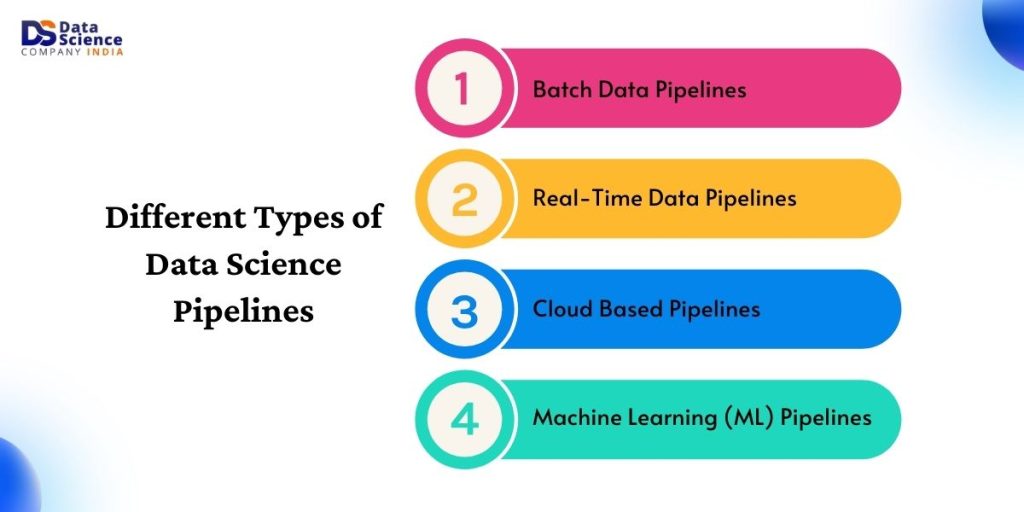
1) Batch Data Pipelines
They’re ideal for businesses that don’t require insights immediately but prioritize processing large datasets effectively.
i) Scheduled Intervals: Widely used for payroll processing and in the finance industry, data is scheduled at predefined cycles such as hourly, weekly, monthly, and yearly.
ii) Structural and Historical Data Analysis: Batch pipelines are excellent for use cases like trend analysis and long-term forecasting since they work well with structured data kept in relational databases.
iii) Less Resource Intensive: This can significantly reduce costs as it consumes fewer computational resources and fewer data updates.
2) Real-Time Data Pipelines
These pipelines are perfect for time-sensitive projects. If your business relies on immediate insights such as fraud detection and monitoring prices, real-time data pipelines are your go-to solution.
i) Immediately Process Data: These pipelines can handle all kinds of data on the fly! It’s helpful if you need to make decisions right away.
ii) Real-time Analytics and Monitoring: If your application is in stock markets or needs to detect fraud immediately, real-time data pipelines can process these data effectively.
iii) Higher Costs: Unfortunately, these pipelines come at a price. Maintaining these pipelines requires a high storage system, low latency networks, and strong processing frameworks.
Related Blog: The Future of Big Data Analytics & Data Science: 6 Trends of Tomorrow
3) Cloud Based Pipelines
These pipelines rely on cloud technology to store, process, and analyze data. Cloud-based pipelines offer a high level of scalability. It means that businesses can store data while creating a physical infrastructure.
i) Scalable and Flexible: These pipelines allow businesses to scale their data processing according to their requirements. This significantly reduces unnecessary operational costs.
ii) Supports Batch and Real-Time processing: Cloud services provide hybrid solutions that can integrate batch and real-time processing, thus adapting to diverse business needs.
iii) Reduces Infrastructure Management Efforts: Since cloud providers handle server maintenance, security, and updates, companies can focus more on data insights rather than infrastructure management.
4) Machine Learning (ML) Pipelines
This is a specialized data science pipeline that automates the steps required to build, train, and deploy machine learning models. This means high-quality, preprocessed data delivered to AI-driven applications.
i) Automates Data Processing: ML pipelines handle organizing data and feature engineering, which reduces manual effort.
ii) Continuous Model Improvement: As new information becomes available, pipelines allow it to be easier for models to be continuously retrained, ensuring that predictions stay current and right.
iii) Integrates with Cloud Infrastructures: Machine learning pipelines can easily be adapted to cloud environments, for greater flexibility.
How Data Science Pipelines Drive Business Success
A well-structured pipeline in data science is an important tool for businesses. With their help, your team can easily process data and make data-driven decisions accurately. Here’s how they can help –
1) Faster Decision Making
i) Automates Data Collection: Helps in streamlining the entire workflow, which reduces the involvement of human intervention and errors.
ii) Eliminates Data Inconsistencies: Now that the data produced will be accurate, the chances of inconsistencies will be zero.
iii) Improves Predictive Capabilities: When pipelines in data science use artificial intelligence, it can help businesses detect vulnerabilities and forecast trends.
2) Improve Data Security
i) Data compliance: These pipelines can be trained to follow all the security regulations like GDPR and CCPA.
ii) Prevention of Data Leaks and Breaches: Secure pipelines help eliminate risks associated with cyberattacks and unauthorized access to sensitive data.
iii) Automates Data Governance Policies: Businesses can set up and enforce usage policies, retention policies, and security policies within the pipeline.
3) Drive Business Growth
i) Identifies New Opportunities: Pipeline data science helps in analyzing customer behavior and market trends that can help businesses discover new opportunities of growth.
ii) Optimizes Customer Experiences: Just by tweaking the campaigns as per the customer data, data science pipelines can help improve customer engagement, loyalty, and sales.
iii) Provides a Competitive Edge: Organizations that use efficient pipelines could outperform competitors by responding to market advances more quickly.
Top 3 Challenges in Building Data Science Pipelines
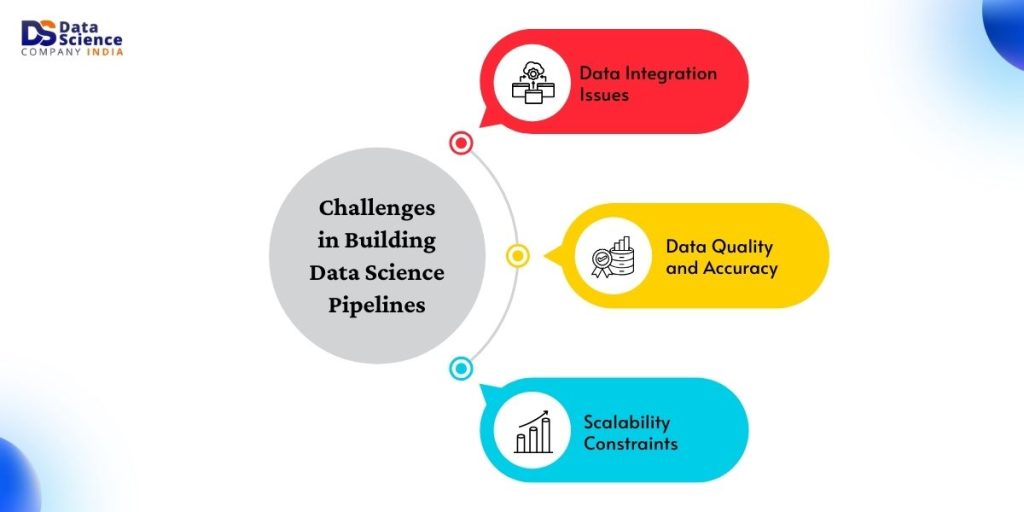
While using pipelines in data science proves to be beneficial in several ways, it has a few limitations of its own. Here are some common challenges that you should be aware of –
1) Data Integration Issues
Collecting data from various sources can be unstructured and there’s a chance that your data gets duplicated. Therefore, it’s advised that you use additional tools like Apache NiFi, Talend, or HevoData to automate data extraction.
2) Data Quality and Accuracy
Due to a lack of standardized data validation and errors in manual data handling, your data quality can drop. This would lead to unreliable insights, causing you unnecessary delays. The best way to tackle this is by automating data cleaning validation, and enrichment processes within the data science pipeline to ensure consistency and accuracy.
3) Scalability Constraints
Scaling your pipeline data science can get hampered due to a large volume of data. Additionally, infrastructure bottlenecks and resource limitations can make you spend more money. The best way to solve this issue is by opting for cloud-based solutions like AWS Data Pipeline and Google Cloud Dataflow.
Conclusion
To sum up, everything that we read, data science pipelines can be beneficial for your business to boost revenue sales and give you a competitive edge. However, it’s equally important to know about the limitations before you invest in it.
The next step? Get in touch with us and let us help you refine your data pipeline. Our team of data scientists can help you get started.
Frequently Asked Questions (FAQ)
Q1. What’s data pipeline?
Ans 1 – A technique that moves data from the initial source to a destination in order to prepare it for analysis and insights is known as a data pipeline. Data is extracted, transformed, and loaded via a sequence of automated processes.
Q2. What’s the role of ELT (Extract, Transform, Load) in a data pipeline?
Ans 2 – It retrieves data from diverse sources, validates and modifies the data and stores the transformed data in a targeted system like a data warehouse.
Q3. What are the main challenges of the data pipeline?
Ans 3 – The main challenges lie in data quality issues, data complexity, and maintaining the pipelines.