
Businesses in today’s data-driven environment process enormous quantities of data arriving from various informational sources. Data discovery tools assume significance in such scenarios.
The data discovery method involves working with data from various sources to produce analysis-based visualizations that detect patterns alongside trending indicators and abnormal points.
Data discovery tools give businesses the capability to use information to implement decisions that foster growth alongside operational efficiency.
The following discussion focuses on the ten most effective data discovery tools that produce practical results to maximize business value from organizational data analytics.
Why do Data Discovery tools matter?
Exhaustive analysis of multifaceted databases through manual techniques leads to both excessive strain and human mistake participation. These tools solve the analysis challenges through automation followed by interactive data visualization capabilities to reveal hidden data patterns that humans miss. These tools are indispensable for:
Identifying patterns and trends: The tools provide researchers with increased visibility into customer trends alongside operational performance questions and market fluctuations.
Accelerating decision-making: You can use the data to make business decisions more promptly while performing both analysis and interpretation.
Enhancing collaboration: Inside the tool, teams can access shared findings through dashboard interfaces combined with easy-to-read reports.
Improving accuracy: Doing proper data interpretation becomes more accurate by reducing potential errors.
A business can position itself for greater marketplace success when it selects the correct data discovery solutions.
Different Aspects of Selecting the Best Data Discovery Tool
Considerations about features and capabilities lead to successful data discovery tool selection. Here are some key factors to consider:
Ease of Use: Technical novices should find the tool simple enough to operate while maintaining an intuitive interface.
Data Visualization: Advanced visualization features, including charts, heatmaps, and graphs, should be sought when making tool selection decisions because they improve insight accessibility.
Integration Capabilities: Verify that the chosen data discovery tool connects seamlessly with all databases alongside existing applications as well as existing platforms.
Scalability: Pick a tool that meets your present workflow needs but can expand to support your growing business.
Security and Compliance: Examine whether the tool fulfills data security standards together with regulatory requirements.
Cost-Effectiveness: Review your pricing model to verify it protects your budget and provides fair pricing relative to other options.
Using these criteria will assist you in choosing a tool that matches your business needs while providing meaningful outcomes.
Related Blog: 10 Best Data Management Software, Tools, and Solutions in 2025
Top 10 Data Discovery Tools
Here is a list of the top 10 data discovery tools that are transforming the way businesses harness their data:
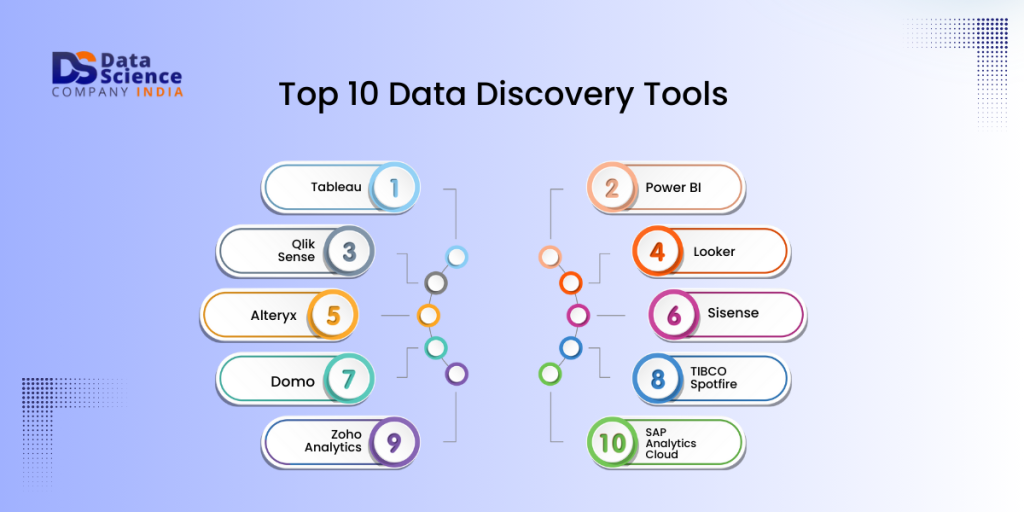
1. Tableau
Overview: Tableau serves as an acclaimed data visualization platform in which organizations around the world place their trust.
Key Features:
Users can construct interactive dashboards with the drag-and-drop toolbox.
Real-time data analysis.
AI-powered insights through Tableau’s “Ask Data” feature.
Ideal for: enterprises, data analysts, and teams handling complex datasets.
Why It Gets Results: Tableau provides businesses with an excellent data visualization solution that connects effortlessly to multiple data sources.
2. Power BI
Overview: Microsoft Power BI delivers data discovery services for building business intelligence reports alongside dashboards.
Key Features:
Integration with Microsoft 365 and Azure.
Extensive visualization library.
Natural language query capabilities.
Ideal For: Businesses of all sizes that implement Microsoft ecosystem solutions.
Why It Gets Results: The efficient combination of Microsoft products with Power BI’s cost-effective solution creates straightforward accessibility in business applications.
3. Qlik Sense
Overview: Qlik Sense delivers self-service data discovery while relying on AI-driven analytics to generate insights.
Key Features:
Associative engine for dynamic exploration of data relationships.
AI-assisted insights for deeper analysis.
Customizable dashboards.
Ideal For: Businesses seeking AI-powered analytics.
Why It Gets Results: User navigation through hidden data patterns stands as Qlik Sense’s key differentiating feature from industry competitors.
4. Looker
Overview: The analytics platform Looker delivers contemporary business intelligence alongside analytical capabilities to Google Cloud customers.
Key Features:
Built-in data modeling capabilities.
Platform users benefit from complete integration with BigQuery, whereas other Google Cloud services synchronize through Looker’s capabilities.
Real-time collaboration features.
Ideal For: Organizations already using Google Cloud.
Why It Gets Results: Looker boasts flawless integration with Google Cloud to deliver both fast and accurate analytics.
5. Alteryx
Overview: Alteryx delivers total data preparation services for blended analytics and business intelligence needs.
Key Features:
Drag-and-drop workflow automation.
The system uses predictive analytics, which operates through machine learning algorithms.
Geospatial analytics.
Ideal for: data scientists and analysts.
Why It Gets Results: Through its analytics feature set, Alteryx enables businesses to gain insights at accelerated speeds.
6. Sisense
Overview: Through embedded analytics, Sisense helps businesses analyze their complex data in simple ways.
Key Features:
The system maintains a flexible structure that manages substantial at-set volumes.
Customizable dashboards and reports.
Integration with cloud services.
Ideal For: enterprises dealing with massive datasets.
Why It Gets Results: Sisense became the perfect tool because of its capability to handle large amounts of data in data-intensive business operations.
7. Domo
Overview: Through its cloud platform, Domo delivers real-time business insights to its users.
Key Features:
The platform features more than one thousand pre-built connectors as part of its data integration system.
Mobile-first design for on-the-go access.
Predictive analytics.
Ideal For: Organizations seeking a mobile-friendly solution.
Why It Gets Results: Real-time data possessed by Domo enables organizations to make speedier assessments.
8. TIBCO Spotfire
Overview: Through TIBCO Spotfire, businesses can perform data visualization while utilizing analytics capabilities alongside machine learning capabilities.
Key Features:
Real-time event analytics.
Real-time information integration features IoT platforms and streaming data streams.
Advanced predictive modeling.
Ideal For: industries like manufacturing and energy.
Why It Gets Results: Businesses that work with real-time data should consider Spotfire because of its powerful IoT capabilities.
9. Zoho Analytics
Overview: The data discovery tool Zoho Analytics offers its users both affordable pricing and an intuitive user experience.
Key Features:
Drag-and-drop report building.
AI-powered assistant for queries.
Integration with Zoho’s suite of business tools.
Ideal For: small to medium-sized businesses.
Why It Gets Results: The tool proves valuable to businesses with small operations because it is budget-friendly and easy to operate.
Related Blog: The Future of Big Data Analytics & Data Science: 6 Trends of Tomorrow
10. SAP Analytics Cloud
Overview: SAP Analytics Cloud delivers complex enterprise-grade analytic capabilities supported with advanced functionality.
Key Features:
Predictive analytics and machine learning.
Integration with SAP’s ERP and CRM systems.
Collaboration tools for team-based insights.
Ideal For: Large enterprises using SAP systems.
Why It Gets Results: The system achieves peak operational efficiency because it integrates seamlessly into SAP’s existing production environment.
How to Choose the Right Tool for Your Business?
Assess Your Needs: You must first specify your main objectives alongside any data obstacles you currently face.
Consider Your Budget: Decide upon the amount you want to spend on implementation.
Evaluate Features: When choosing tools, seek features that integrate with your business and leverage scalability options while ensuring adequate data security.
Test the Tools: The exploration of usability and compatibility options requires you to utilize free trial and demo periods.
Gather Feedback: Obtain preferences from everyone in your team.
Concluding Thoughts
Various modern tools exist to transform unprocessed data into meaningful information that produces action-related conclusions. Businesses can achieve decision-making value as well as operational efficiency improvements and market leadership with proper tool investments.
All the tools presented in this document are suitable for businesses of any size, from small start-ups to large enterprises. Invest in these tools today so you can extract complete value from your data.
FAQs
What are data discovery tools used for?
The purpose of data discovery tools is to reveal hidden patterns and trends alongside valuable insights within business information. These data visualization solutions facilitate the data accumulation phase, followed by statistical research and data display features that lead to decision-making intelligence.
Data discovery tools serve analytic and business intelligence and predictive modeling operations.
Can data discovery tools integrate with existing systems?
Modern data discovery tools provide native database integration capabilities together with automated support for CRM cloud storage solutions and other corporate systems.
The level of integration between tools differs greatly so companies need to select solutions that match current business technology requirements.
Are data discovery tools suitable for small businesses?
Absolutely. Modern data discovery tools provide scalable pricing models that allow small businesses to acquire them. Startups and small organizations can access free and low-priced versions of data discovery tools from Power BI and Tableau.
Modern business tools enable small businesses to acquire insights, which leads to operational enhancements at minimal financial investment.